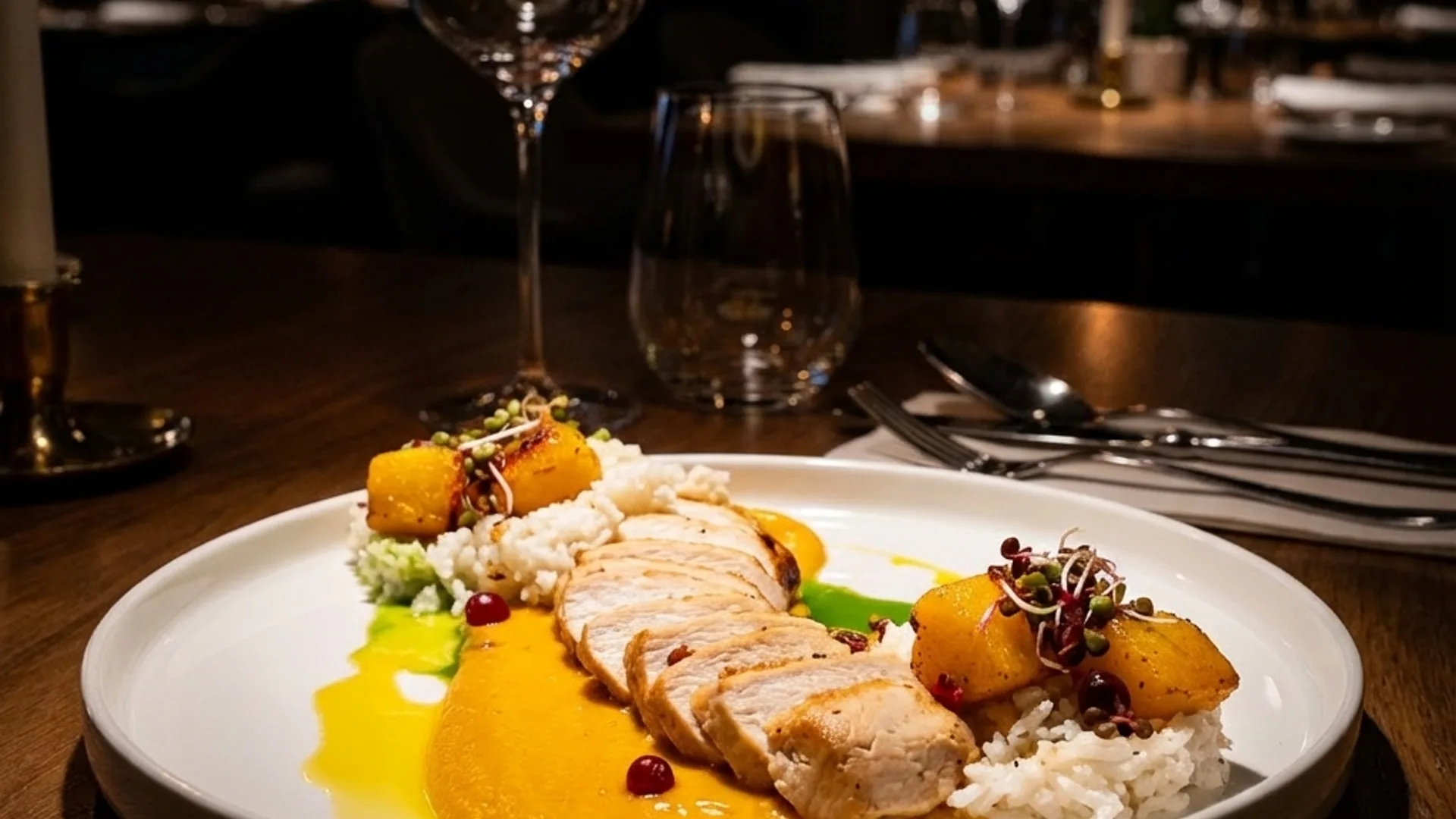
How AI food photography works — the complete guide for restaurants
This guide covers everything about AI food photography for restaurants: how the technology works, what it costs compared to a photographer, how to choose a tool, and where it falls short.
How does AI food photography work?
The process takes three steps and less than a minute. First, upload 3 photos of your restaurant interior so the AI learns your lighting, ambience and aesthetic. Then upload the dish photo you want to transform — a well-lit phone photo is enough. Finally, pick a style: fine dining nighttime, natural daylight, studio precision for delivery, fast casual energy, cozy bistro warmth, or any of the 9 professional styles available. In 30–60 seconds you get a professional image of your real dish in your real restaurant.
See how FoodyFocus works, step by step
What is AI food photography used for?
Restaurants use AI food photography to refresh digital menus and printed menu cards, populate Google Business Profile listings, post on Instagram, Facebook and TikTok, upload to Uber Eats (1200×960 px), DoorDash (1200×900 px), Deliveroo (1920×1080 px), Just Eat (1200×800 px) and Glovo (1000×1000 px), run paid ads on Meta and Google, and send email marketing campaigns. All images include full commercial rights — yours to use anywhere with no licensing fees.
AI food photography vs hiring a food photographer
The gap comes down to time and cost. A traditional session takes 1–3 weeks between booking, shooting and retouching, and runs from a few hundred to several thousand dollars or euros depending on the market (see the regional breakdown below). With FoodyFocus, the Basic plan (30 images/month) is €19 total — less than the cost of a single retouched photo elsewhere — and results arrive in under a minute, so you can refresh your menu as often as it actually changes.
How much does AI food photography cost?
FoodyFocus pricing is flat monthly, with no per-shoot fees and no licensing costs. Free gives you 3 images to trial the quality with no credit card. Basic is €19/month for 30 images — that works out at roughly €0.63 per photo. Premium is €49/month for 100 images, about €0.49 each. The Full Package is €109/month for 250 images, around €0.44 each. Compare that to the €300–€800 a single European session costs, or the $800–$2,000 a 10-photo retouched package runs in the US, and a full year of Premium still costs less than one traditional shoot. Plans can be changed or cancelled at any time.
Compare full pricing and plans
Image specs for every delivery app and social platform
Each marketplace enforces its own image rules, and listings with non-compliant photos are often rejected or displayed badly cropped. FoodyFocus exports the correct dimensions directly: Uber Eats at 1200×960 px, DoorDash at 1200×900 px, Deliveroo at 1920×1080 px, Just Eat at 1200×800 px, Glovo at 1000×1000 px square, and Wolt at 1024×768 px. For social, you get 1:1 for the Instagram grid, 9:16 vertical for Stories, Reels and TikTok, and 16:9 landscape for digital menu boards and websites. One generation exports to every format without re-cropping or quality loss.
Food photography prices by region: what a photographer charges
Rates vary sharply by market, which is why so many operators are surprised by their first quote. In the United States, a session typically runs $500–$5,000, with hourly rates of $100–$500; a retouched 10-photo package commonly lands between $800 and $2,000, and metro rates in New York and Los Angeles sit at the top of that range. In the United Kingdom, expect £400–£1,500 per day, higher for central London studio work. Across continental Europe, €300–€800 per session is typical, with Madrid at €60–150/hour, Barcelona €50–100/hour and Valencia €40–80/hour. Food styling, props, travel and licensing are usually billed on top.
Full breakdown: how much food photography costs in 2026
How to choose an AI food photography tool
Judge tools on five things. Does it preserve your actual dish, or generate a plausible-looking substitute that will not match what you serve? Does it output the exact pixel dimensions each delivery marketplace requires, or leave you cropping by hand? Are full commercial rights included, or licensed per image? Where is your data processed and stored — relevant if you operate in the EU and need GDPR compliance? And can you regenerate freely when a result misses, or does every attempt consume paid credit? Authenticity matters most: an image that oversells the plate produces refund requests and one-star reviews, which costs far more than the photo saved.
Honest comparison of the 7 best AI food photography tools
AI food photography for Google Business Profile
Google Business Profile is where most local restaurant discovery now begins, and listings with strong, current photography attract materially more engagement than those relying on a handful of customer snapshots. Google favours images that are well lit, correctly oriented and genuinely representative of the business. Profiles benefit from a consistent set: signature dishes, a few menu highlights, drinks and the interior. AI food photography makes it practical to keep that set fresh as the menu changes, instead of leaving a profile dominated by whatever photos diners happened to upload years ago.
Google Business Profile photos for restaurants: 2026 guide
How to get the best results from AI food photography
Quality in, quality out. Shoot your dish near a window in indirect daylight rather than under yellow ceiling bulbs, which cast a colour tint the model has to correct. Fill the frame with the plate and shoot from the angle you want to sell — 45° for layered dishes like burgers and cakes, straight overhead for flat plates, bowls and pizzas. Wipe drips off the rim before shooting. Upload interior photos that genuinely reflect your room's lighting, because that is what the AI matches the dish to. If a result is not right, regenerate with a different style rather than settling — regenerations are quick and included in your plan.
Eight-step workflow: from smartphone to star dish
AI food photography vs stock photos
Stock photography is the cheap alternative most restaurants reach for, and it is the reason so many delivery listings show the same generic burger. Customers increasingly recognise stock imagery, and a dish that arrives looking nothing like the photo drives complaints, refund requests and poor reviews. Several delivery marketplaces also restrict or prohibit stock imagery for menu items. AI food photography solves the mismatch problem differently: the image is generated from a photo of the dish you actually serve, in the room you actually serve it in, so what the customer sees is what arrives at the table.
What AI food photography can't do
Being straight about the limits: AI cannot invent a dish it has never seen, so you need a usable photo of the real plate to start from. It will not fix a photo that is badly out of focus, shot in near darkness, or where the food is mostly hidden. It does not replace a photographer for genuine editorial storytelling, chef portraits, venue interiors or press features, which still benefit from a human eye. And it will not make a poorly plated dish look appetising — presentation still matters. What it does well is the repetitive, high-volume commercial work: menu items, delivery listings and social posts, refreshed as often as you need.
Frequently asked questions
Is AI-generated food photography realistic?
Yes. FoodyFocus uses AI models trained specifically on restaurant food photography and combines your real dish photo with your real restaurant ambience. The output is not generic stock photography — it's an image showing your specific dish in your specific restaurant, indistinguishable from a professional shoot for everyday commercial use.
Do I need a professional camera to get good results?
No. A well-lit photo from any modern smartphone (iPhone, Samsung, Pixel, etc.) is sufficient. The key is good lighting (natural light near a window works perfectly) and a clear view of the dish. The AI handles the rest — background, color correction, lighting style, composition.
How fast is AI food photography?
30 to 60 seconds per image. That's compared to 1-3 weeks for a traditional photographer to deliver retouched photos after a shoot. You can generate, review, regenerate and publish all in a single session.
Can I use these photos on Uber Eats, DoorDash, and Deliveroo?
Yes, with no restrictions. FoodyFocus generates photos with the exact dimensions each platform requires: Uber Eats (1200×960 px), DoorDash (1200×900 px), Deliveroo (1920×1080 px), Just Eat (1200×800 px) and Glovo (1000×1000 px). Files are ready to upload directly to each platform's Menu Manager.
Is there a free trial?
Yes. The Free plan includes 3 trial images with no credit card required. It's the easiest way to test the quality before committing to a paid plan.
How much does AI food photography cost per photo?
It depends on your plan. On Basic (€19/month for 30 images) each photo costs about €0.63. On Premium (€49/month for 100 images) it's roughly €0.49. On the Full Package (€109/month for 250 images) it's around €0.44 per image. There are no per-shoot fees, no retouching charges and no licensing costs on top.
Do I own the rights to the images I generate?
Yes. Paid plans include full commercial rights to every image you generate. You can use them on your menu, delivery listings, website, social media, paid advertising and printed materials, with no licensing fees, no attribution requirement and no expiry.
Can AI food photography completely replace a food photographer?
For high-volume commercial work — menu items, delivery app listings, social posts and seasonal specials — yes, and at a fraction of the cost. For editorial storytelling, chef portraits, venue interiors and press features, a human photographer still brings something AI does not. Many restaurants use both: AI for the recurring menu work, a photographer once a year for brand imagery.
What happens if I don't like the generated image?
Regenerate it. You can try a different style, a different angle or a different ambience, and paid plans include monthly edit credits for exactly this. Because each generation takes under a minute, iterating to a result you're happy with is a matter of minutes rather than another paid shoot.
Which cuisines and dish types does it handle?
Any dish you can photograph. Restaurants use FoodyFocus for burgers, pizza, sushi, ramen, tapas, paella, curries, desserts, pastries, cocktails, coffee and plated fine dining. Dishes with clear structure and contrast tend to produce the strongest results; very uniform dishes such as soups and purées benefit from a garnish or a styled angle.
Is my data safe and where is it stored?
Your photos and personal data are processed and stored exclusively on European servers, in full compliance with GDPR. FoodyFocus is headquartered in Barcelona, Spain. Your dish photos and restaurant interiors are used to generate your images and are not sold or shared with third parties.
Built by the FoodyFocus team in Barcelona. See who we are →
