ai food photography vs professional photography · ai food photographer · professional food photography · ai restaurant photography
AI Food Photography vs Professional Photography: Which Is Better?
Compare AI food photography and professional food photography for restaurants, including cost, quality, speed, consistency and the best use cases for each.
Restaurant photography used to involve a relatively simple choice: hire a professional photographer or take the photos yourself. Artificial intelligence has added a third option.
Today, restaurants can use AI-powered tools to improve existing food photos, change backgrounds, correct lighting, create more consistent compositions, and produce polished menu images without organizing a traditional photoshoot every time the menu changes.
That raises an obvious question: Is AI food photography actually a good alternative to professional food photography?
The answer depends on what you're trying to achieve.
A professional photographer offers creative direction, technical expertise, food styling, and the ability to capture an entire restaurant experience. AI, on the other hand, can make image production faster, more flexible, and potentially more affordable — particularly when a restaurant already has photographs of its real dishes.
For many restaurants, the best solution may not be choosing one and rejecting the other. It may be understanding where each approach works best and combining them strategically.
This guide compares AI food photography and traditional professional photography across cost, quality, speed, consistency, flexibility, and authenticity to help you decide which approach makes sense for your restaurant.
What Is AI Food Photography?
AI food photography refers to the use of artificial intelligence to create, enhance, or transform images of food.
The term covers several very different processes, and the distinction between them matters.
At one end of the spectrum, AI can be used to improve a photograph of a real dish. A restaurant takes a photo — potentially even with a smartphone — and AI helps improve elements such as lighting, background, composition, or overall presentation.
At the other end, generative AI can create an entirely new image of food from a text description without using a photograph of the restaurant's actual dish.
These are not the same thing.
For restaurants, the first approach is generally more practical because the original food remains connected to the product being sold. The technology is being used to improve the presentation of a real dish rather than inventing one that may not exist.
AI-assisted photography can potentially help with:
- Background replacement and cleanup
- Lighting and exposure adjustments
- Image enhancement
- Composition improvements
- Visual consistency across menu photos
- Adapting existing images to different formats
The objective is usually to make restaurant photography easier to produce and maintain at scale.
What Does a Professional Food Photographer Do?
Professional food photography involves considerably more than pointing an expensive camera at a plate.
A photographer may work alongside a food stylist, chef, art director, restaurant owner, or marketing team to determine how the food and brand should be represented. Lighting is carefully controlled, compositions are planned, props and surfaces are selected, and each dish may be adjusted specifically for the camera.
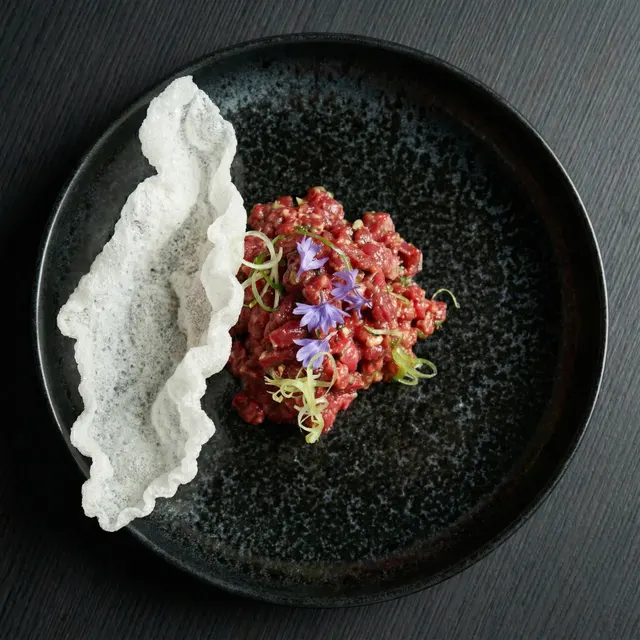
A professional shoot can also capture much more than menu items. During the same production, a restaurant might create photographs of its interior, chef, team, bar, kitchen, service, cocktails, and overall atmosphere.
This makes professional photography particularly valuable when the objective is to build a complete visual identity rather than simply update a few menu images.
The trade-off is that professional production requires planning. The restaurant needs to coordinate schedules, prepare dishes, organize the space, and allocate a budget. If a new dish is added two weeks later, organizing another professional shoot may not be practical.
This is where the difference between the two approaches becomes clearer.
AI vs Professional Food Photography: Quick Comparison
| AI-Assisted Food Photography | Professional Food Photography | |
|---|---|---|
| Initial cost | Typically lower | Typically higher |
| Production speed | Fast | Requires planning and shooting |
| Menu updates | Easy to produce regularly | May require another shoot |
| Consistency | Can standardize existing images | High when shot in one session |
| Creative control | Depends on the tool | High |
| Real-world accuracy | Depends on how AI is used | Captures the actual dish |
| Brand photography | More limited | Strong |
| Interior photography | Not the primary use case | Strong |
| People and atmosphere | Limited | Strong |
| Scalability | High | More resource-intensive |
| Best suited for | Menus, delivery, frequent updates | Brand campaigns, websites, press, hero imagery |
This comparison isn't absolute. The results depend heavily on the quality of the photographer, the AI technology being used, and the restaurant's original images.
Still, it highlights the fundamental difference: professional photography is primarily a production process, while AI photography can function as an image-production and post-production system.
1. Cost
Cost is one of the main reasons restaurants consider AI photography.
A professional photoshoot can involve more than the photographer's fee. Depending on the scale of the production, the total cost may include food preparation, styling, assistants, equipment, studio or location time, and post-production.
For a major restaurant launch or brand campaign, that investment can make sense. The resulting images may be used for months or even years across websites, advertising, PR, and social media.
The challenge appears when photography becomes an ongoing operational need.
Restaurants change menus. Seasonal dishes arrive. Specials disappear. Delivery menus expand. New locations open. A restaurant may need ten new photographs without needing — or being able to justify — an entirely new brand photoshoot.
AI-assisted workflows can reduce the production required for these smaller, recurring updates. If the restaurant can start with a reasonable photograph of the real dish, AI may help turn it into a more polished and consistent image.
The relevant cost comparison, therefore, isn't simply "AI is cheaper than a photographer." A better question is: does your restaurant need new visual content frequently, and what level of production does each image actually require?
2. Image Quality
Professional photography still has a major advantage when the objective is complete creative control.
An experienced food photographer can make deliberate decisions about lighting, camera position, depth of field, texture, styling, reflections, and composition while the food is physically present. Problems can be corrected during the shoot rather than repaired afterwards.
For important brand images, that level of control is difficult to replace.
AI can produce polished results, but the quality depends heavily on the starting image and the type of transformation being made. Improving a distracting background is one thing. Correcting a poorly photographed dish with missing detail, extreme blur, or an unsuitable angle is much more difficult.
There is also a point at which excessive AI transformation can make food appear unnatural. Textures may become too perfect, ingredients can change, shadows may not make physical sense, or small details may reveal that the image has been heavily generated.
For restaurant photography, "high quality" shouldn't simply mean visually impressive. The image also needs to be believable and representative of the food.
3. Speed
This is where AI has a clear practical advantage.
A professional photoshoot requires coordination. The photographer needs to be available, the dishes need to be prepared, the space may need to be staged, and the images still require selection and post-production.
AI-assisted production can be considerably faster, particularly when a restaurant already has usable source photographs.
Imagine a restaurant launching three seasonal dishes.
Organizing a full professional shoot for three images may be inefficient. Instead, the team could photograph the dishes using a smartphone in a consistent setup and then use AI-assisted editing to bring those images closer to the visual style of the existing menu.
This type of workflow makes photography more responsive to the actual pace at which restaurants operate.
4. Consistency
Consistency is one of the less obvious challenges in restaurant photography.
A restaurant may have accumulated photographs over several years. Some were taken professionally. Others came from staff members. A few were photographed for delivery. New dishes were captured on smartphones.
Individually, some of these photographs may be perfectly acceptable.
Together, they may look like they belong to five different restaurants.
Professional photography solves this problem very effectively when everything is photographed during the same production. The lighting, equipment, background, editing, and creative direction can remain consistent.
The problem is maintaining that consistency six months later when the menu changes.
AI can potentially help standardize certain visual elements across existing photographs, particularly backgrounds and overall presentation. This makes it useful not only for creating new images but also for improving the coherence of an existing menu library.
The strongest approach is to establish a clear visual system first. AI can help maintain consistency, but it shouldn't be expected to define the restaurant's entire visual identity automatically.
5. Authenticity and Accuracy
This is one of the most important considerations for restaurants using AI.
Customers expect the photograph to represent what they are buying.
Traditional photography starts with the actual dish. While food styling and editing can certainly make it look more attractive, the underlying subject is still physically present.
Generative AI can go much further. It can add ingredients, change portions, alter textures, or create food that was never photographed in the first place.
That creates a potential problem.
A visually spectacular image may generate an order, but if the food that arrives looks substantially different, the photograph has created the wrong expectation.
For this reason, restaurants should distinguish between AI enhancement and AI invention.
Using AI to clean up the background behind a real burger is fundamentally different from generating an imaginary burger and presenting it as a menu item.
For commercial restaurant photography, accuracy should remain a priority regardless of which technology is used.
6. Flexibility
Restaurants rarely need images for only one purpose.
The same dish may appear on:
- A delivery platform
- The restaurant website
- An online menu
- A digital advertisement
Each channel may require different dimensions and compositions.
Professional photographers can plan for this by shooting multiple orientations and leaving enough space for different crops. This works extremely well when the required formats are known before the shoot.
AI tools can add flexibility after the image already exists. Depending on the technology, restaurants may be able to adjust backgrounds, extend compositions, or adapt an existing photograph for different formats.
This can make an existing photo library more versatile, although significant transformations should always be reviewed carefully to ensure the food remains accurate.
7. Brand and Lifestyle Photography
AI food photography and professional photography are not equally suited to every type of content.
If you need clean, consistent images of individual menu items, AI-assisted workflows may be highly practical.
If you need to capture the feeling of a Saturday evening in your restaurant, professional photography is usually the stronger option.
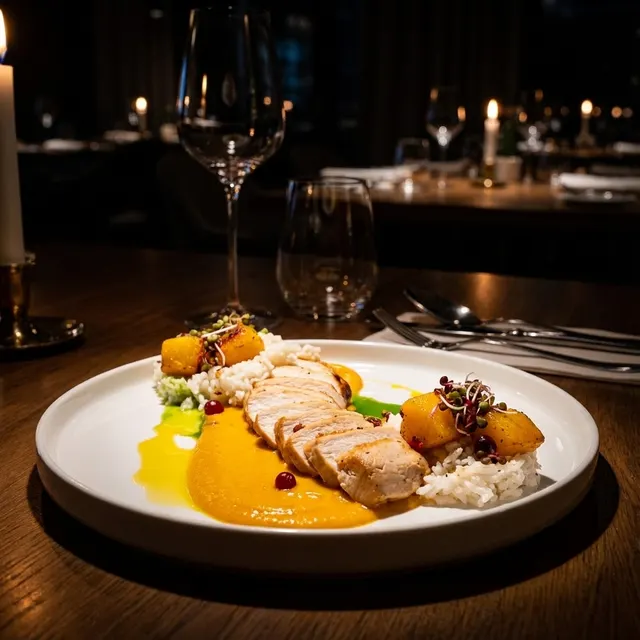
Atmosphere depends on real details: the interaction between staff and guests, the lighting in the dining room, the chef working in the kitchen, the architecture, the energy of the bar.
These are not simply product images. They are part of the restaurant's identity.
A professional photographer can observe and interpret these elements in context. This makes traditional photography particularly valuable for brand storytelling, editorial content, press, and major campaigns.
When Should a Restaurant Choose Professional Photography?
Professional photography is generally the stronger choice when you are creating high-value, long-term brand assets.
Consider hiring a professional photographer when you are:
- Launching a new restaurant
- Redesigning your website
- Creating a major advertising campaign
- Preparing press materials
- Photographing your interior
- Building your core brand image library
- Creating chef or team portraits
- Capturing service and atmosphere
These images may represent your restaurant for a long time, so investing more in production can be justified.
A strong professional photoshoot can also provide the foundation for everything that follows.
When Does AI Food Photography Make More Sense?
AI-assisted photography becomes particularly useful when speed, scalability, and frequent updates are priorities.
It may make sense when you need to:
- Add new menu items regularly
- Update seasonal dishes
- Improve existing food photographs
- Create more consistent menu backgrounds
- Refresh delivery-app photography
- Work with a limited photography budget
- Process a large number of menu images
This is especially relevant for restaurants that already have photographs of their dishes but aren't satisfied with how inconsistent or unpolished the overall menu looks.
Rather than replacing the entire photography process, AI can become another tool within it.
The Hybrid Approach: Professional Photography + AI
For many restaurants, this is likely to be the most practical strategy.
Use professional photography to establish the visual identity.
Create your core library with high-quality images of the restaurant, signature dishes, chef, team, interior, and atmosphere.
Then use that library as a visual reference.
When new menu items appear, photograph the real dishes using a repeatable smartphone setup. AI-assisted tools can then help improve and standardize those images so they fit more naturally with the restaurant's established visual style.
The workflow might look like this: professional photoshoot, then core visual identity, then new dish photographed in-house, then AI-assisted enhancement, then a consistent menu update.
This approach uses each method for what it does best.
Professional photography provides creative direction and high-value brand assets.
In-house photography provides speed.
AI helps bridge the consistency gap.
What About Fully AI-Generated Food Images?
This is where restaurants should be more cautious.
A fully generated image can look extremely realistic while having no direct relationship to the dish being served.
That may be acceptable for conceptual advertising where the imagery is clearly illustrative. It is much more problematic when the image appears next to a specific menu item that a customer is about to order.
The closer an image is to the point of purchase, the more important accuracy becomes.
A useful principle is: the image should help customers understand what they are buying — not create a product that exists only in the image.
Restaurants should also check the current image and content policies of any third-party platform where AI-generated or AI-edited photographs will be uploaded.
So, Which Is Better?
Neither approach is universally better.
Professional food photography offers something AI cannot fully replicate: deliberate creative direction around a real dish, in a real space, with control over the entire production.
AI offers something traditional photography struggles to provide economically: the ability to update, adapt, and standardize visual content quickly and at scale.
The right choice depends on the task.
| If you need... | Consider... |
|---|---|
| A complete brand photoshoot | Professional photographer |
| Restaurant interior photography | Professional photographer |
| Chef and team portraits | Professional photographer |
| Major campaign imagery | Professional photographer |
| New menu items every month | AI-assisted workflow |
| More consistent delivery photos | AI-assisted workflow |
| Improvement of existing food photos | AI-assisted workflow |
| A complete long-term content system | Hybrid approach |
For many restaurants, the real question is no longer AI or professional photography. It's where should we use each one?
Frequently Asked Questions
Can AI replace a professional food photographer?
For some types of menu photography, AI may reduce the need for frequent professional shoots. However, professional photographers remain particularly valuable for creative direction, brand campaigns, restaurant interiors, people, atmosphere, and high-value hero imagery.
Is AI food photography cheaper than professional photography?
AI-assisted workflows can reduce production costs, particularly for frequent menu updates or large volumes of images. However, the exact cost depends on the tool, service, number of images, and quality of the original photographs.
Can AI make smartphone food photos look professional?
AI can help improve certain aspects of smartphone photographs, including backgrounds, lighting, and overall consistency. However, the quality of the original photograph still matters. Good lighting, focus, and camera angle provide a much stronger starting point.
Is it acceptable to use AI-generated images on a restaurant menu?
Restaurants should be cautious with fully generated images that don't accurately represent the food being sold. Platform policies may also differ, so current requirements should be checked before publishing AI-generated content.
Should restaurants use AI or hire a photographer?
It depends on the purpose. Professional photography is generally better suited to major brand assets and complete restaurant photoshoots, while AI-assisted photography can be useful for frequent menu updates and improving existing images. A hybrid approach may offer the most flexibility.
The Future Isn't Necessarily AI vs. Photography
AI is changing how restaurants can produce visual content, but that doesn't make professional photography obsolete.
The two approaches solve different problems.
A photographer can define how a restaurant should look.
AI can help maintain and scale that visual system.
For a restaurant launching a new concept, investing in professional photography may still be one of the strongest ways to create a high-quality visual identity. But calling a photographer every time a seasonal dessert changes is rarely practical.
That's where a more flexible workflow becomes useful.
Build a strong visual foundation. Establish your photography style. Create a repeatable process for new dishes. Then use the right combination of professional photography, smartphone photography, and AI-assisted tools to keep your content current.
The objective isn't to replace one method with another.
It's to make sure that every time a potential customer sees your food, the image is clear, appealing, consistent, and representative of what they can actually order.
If you want to understand the technology in more detail, read our Complete Guide to AI Food Photography for Restaurants.
If you're creating source images yourself, see How to Take Professional Food Photos With Your Phone.
And if you're planning a full restaurant shoot, use our Restaurant Photography Checklist: Every Photo Your Restaurant Needs.
